Friday
First Look At The New Spider-Man
Ever since word of a "Spider-Man" reboot was announced, fans have been hungry for any scrap of info about the movie. How will this version differ from Sam Raimi’s hugely successful franchise? How will Andrew Garfield's Peter Parker stack up against Toby Maguire's? Today, we get an early look at the upcoming flick. Check out the pic below.

I see it as a massive challenge in many ways," he told Details magazine. "To make it authentic. To make the character live and breathe in a new way. The audience already has a relationship with many different incarnations of the character. I do, as well. I'm probably going to be the guy in the movie theater shouting abuse at myself. But I have to let that go. No turning back. And I wouldn't want to.
Labels: Movies, Shows, Spider Man, Story, Videos
# posted by Dany @ 5:53 AM

Saturday
View From House Snow Balls
Prove that the simple snow balls may be something more than just a souvenir to come from Walter Martin and Paloma Muñoz.
They served as inspiration for the view from their house in the highlands of eastern Pennsylvania, and materials for the balls themselves - absolutely everything that can be caught by the arm.


Labels: Art, Cool, Creativity, Events, Funny, Interesting, Story, Toys, Wonderful
# posted by Dany @ 5:01 AM
Friday
10 Christmas Survival Tips For The Newly Divorced

I cannot think of Christmas without a vision of family. What if you are alone this Christmas? Not only do you not have your spouse but you don’t have your kids? The first thing I need to tell you is you are not alone; 50% of marriages split up and there are often kids in that mix. Either you or your ex has to be without their children on Christmas Eve or Christmas.
When you are newly divorced or separated this can feel like an overwhelming loss. Hauling out the ornaments and decorations may bring a flood of memories. It is common to ask yourself if the divorce or separation was necessary. Could you have worked through it? This ambiguity is heightened when you go to the mall and see couples hand in hand. You begin to wonder if you could have done something differently to make it work. Remembering the good times makes you more likely to feel depressed when you are newly divorced. Feeling sorry for yourself won’t make the situation go away.
There are things you can do to make this Christmas less heartbreaking and give you a deeper sense of gratitude. Children are barometers for parents, and if they see a parent unhappy it will make them feel sad. Don’t make your kids suffer your loneliness in your first Christmas without them. Make a plan now, and Christmas Eve will be a bit less painful.
1. Think out of the box. You don’t need to have the same traditions you had when you were married. If you are alone it is an opportunity to start over and do what really matters to you.
2. Make a plan to call your children at a particular time. Negotiate with your ex regarding what time would be good so as not to interfere with their holiday plans (the more you support your ex in being a good parent, the better chance your children have of growing up to be confident, well-adjusted people).
3. Invite family or friends over for Christmas Eve. The more you focus on serving others the deeper meaning Christmas will have for you.
4. If your kids are going to be gone for two or three days and you cannot bear being in the house alone, plan a short trip. Instead of buying gifts no one needs, splurge on a short trip you always wanted to take. People are very friendly this time of year, and most likely you will not have to struggle to make friends.
5. Allow yourself to do whatever you could not do when the kids were with you. Take a hot bath, or stay up and read until 3 a.m.
6. Watch a movie that makes you feel uplifted.
7. Do something creative. Maybe a room in the house needs to be painted. You are alone, and no one said that you cannot decorate or fix up the house on Christmas Eve. Make it your own holiday, and do what takes your mind off your loneliness.
8. Remember that divorce shatters both partners’ self esteem. This is not a good time to be looking for Mr. or Mrs. Right. Much wiser to call an old friend and ask them if they can listen for a while.
9. Write your story. The more people can write about their thoughts and feelings the quicker they can work through them and gain understanding. Who knows, you may be creating a best seller.
10. Light a candle, turn on soft music and pray. You are a spiritual being having a human experience and this part of being a human is painful.
Most people are afraid of being alone. For many the fear keeps them trapped in broken relationships and broken families. If your marriage didn’t work out, and you do find yourself alone at Christmas, celebrate the fact that you aren’t trapped in a marriage that was broken. Look to tomorrow, believe in the lessons you learned today. You're going to be okay.
Labels: Christmas, Cool, Story
# posted by Dany @ 2:59 AM
Thursday
25 Terrifying, Thoughtful and Absurd Nursery Rhymes for Children
In more repressed times, people were not always allowed to express themselves freely, for fear of persecution. Gossiping, criticizing the government or even talking about current events were often punishable by death. In order to communicate at will, clever rhymes were constructed and passed around to parody public figures and events.
The first nursery rhymes can be traced back to the fourteenth century. While the Bubonic Plaque ravaged England, peasants used a rhyme to spread the word about equality. The "Adam and Eve" rhyme made peasants realize that they were important to the economy and contributed to the Peasants Revolt of 1381. Under the guise of children's entertainment, many rhymes that were encoded with secret messages throughout history have endured the test of time and are still with us today.
Other nursery rhymes don't seem to carry a particular message at all, but convey a macabre sense of humor. They have been so ingrained in us since childhood that we hardly notice that babies are falling from trees, women are held captive or live animals are being cooked. It's only when you stop and absorb the actual words of these catchy, sing-song rhymes that the darkness and absurdity is realized. A handful do not reference historical events at all, but instead seem to convey warnings or common sense wisdom.
Humpty Dumpty

Humpty Dumpty sat on a wall,
Humpty Dumpty had a great fall,
All the King's Horses and all the King's men
Couldn't put Humpty together again.
Humpty Dumpty had a great fall,
All the King's Horses and all the King's men
Couldn't put Humpty together again.
In children's books, Humpty Dumpty is portrayed as a large egg, usually dressed like a little boy. It's a sad story, as he gets busted up and nobody can fix him. However, the real story behind the rhyme dates back to the English Civil War. Humpty was a huge cannon mounted atop a high wall-like church tower. During the Siege of Colchester, The tower was hit by enemy cannon fire and Humpty suffered a great fall. There was no fixing the cannon or the tower, and the Humpty Dumpty rhyme was born.
Ring Around The Rosie

Ring around the rosy
A pocketful of posies
"Ashes, Ashes"
We all fall down!
A pocketful of posies
"Ashes, Ashes"
We all fall down!
This rhyme dates back to the Great Plague of London in 1665. The symptoms of bubonic plague included a rosy red ring-shaped rash, which inspired the first line. It was believed that the disease was carried by bad smells, so people frequently carried pockets full of fresh herbs, or "posies." The "ashes, ashes" line is believed to refer to the cremation of the bodies of those who died from the plague.
Baa Baa Blacksheep

Baa baa black sheep, have you any wool?
Yes sir, yes sir, three bags full!
One for the master, one for the dame
And one for the little boy who lives down the lane
Yes sir, yes sir, three bags full!
One for the master, one for the dame
And one for the little boy who lives down the lane
Baa Baa Black Sheep references the importance of the wool industry to the economy from the Middle Ages until the nineteenth century. The rhyme is also thought to be a political satire of the export tax imposed in Britain in 1275 under the rule of King Edward I.
For Want of a Nail

For want of a nail the shoe was lost
For want of a shoe the horse was lost
For want of a horse the rider was lost
For want of a rider the battle was lost
For want of a battle the kingdom was lost
And all for the want of a horseshoe nail
For want of a shoe the horse was lost
For want of a horse the rider was lost
For want of a rider the battle was lost
For want of a battle the kingdom was lost
And all for the want of a horseshoe nail
This simple rhyme is a reminder for children to think of the possible consequences of their actions. It has often been used to illustrate the chain of events that can stem from a single thoughtless action.
Mary, Mary Quite Contrary

Mary Mary quite contrary,
How does your garden grow?
With silver bells and cockle shells
And pretty maids all in a row
How does your garden grow?
With silver bells and cockle shells
And pretty maids all in a row
This rhyme is a reference to Bloody Mary. The garden refers to growing cemeteries, as she filled them with Protestants. Silver bells and cockle shells were instruments of torture and the maiden was a device used to behead people.
Goosey, Goosey Gander

Goosey, goosey, gander,
Whither dost thou wander?
Upstairs and downstairs
And in my lady's chamber.
Whither dost thou wander?
Upstairs and downstairs
And in my lady's chamber.
There I met an old man
Who wouldn't say his prayers;
I took him by the left leg,
And threw him down the stairs
Who wouldn't say his prayers;
I took him by the left leg,
And threw him down the stairs
While Mother Goose seems like a kind, grandmotherly sort, the gander in this rhyme appears to be quite a bastard. This sixteenth century rhyme is a reminder to children to always say their prayers.
It's Raining, It's Pouring

It's raining, it's pouring
The old man is snoring
He went to bed and he bumped his head
And couldn't get up in the morning
The old man is snoring
He went to bed and he bumped his head
And couldn't get up in the morning
In this strange nursery rhyme, the man apparently was careless in going to bed and didn't wake up. We can only assume it's a message to be cautious when you're on your way to bed.
Rock-a-Bye, Baby

Rock-a-bye, baby,
In the tree top.
When the wind blows,
The cradle will rock.
When the bough breaks,
The cradle will fall,
And down will come baby,
Cradle and al
In the tree top.
When the wind blows,
The cradle will rock.
When the bough breaks,
The cradle will fall,
And down will come baby,
Cradle and al
The American roots of this odd rhyme come from a young pilgrim who saw Native American mothers hanging cradles in trees. When the wind blew, the cradles would rock and the babies in them would sleep.
Peter, Peter, Pumpkin Eater

Peter , Peter , pumpkin-eater,
Had a wife and couldn't keep her;
He put her in a pumpkin shell,
And there he kept her very well
Had a wife and couldn't keep her;
He put her in a pumpkin shell,
And there he kept her very well
This nursery rhyme also has it's roots in America, unlike most that started in England. It was a different time back then for women, and for views on divorce, too, which is why this rhyme served to warn young girls about infidelity. Peter's wife was supposedly a harlot, and Peter's remedy for the situation was to kill her and hide her body in a giant pumpkin shell.
Sing a Song of Sixpence

Sing a song of sixpence a pocket full of rye,
Four and twenty blackbirds baked in a pie.
When the pie was opened the birds began to sing,
Oh wasn't that a dainty dish to set before the king?
Four and twenty blackbirds baked in a pie.
When the pie was opened the birds began to sing,
Oh wasn't that a dainty dish to set before the king?
This rhyme most certainly originated long ago, before PETA existed. It was likely based on a spoof by a court jester who thought it would be hilarious to trick the king by putting live birds into a pie shell. At the time, cooked blackbirds were considered a delicacy and would have been served to the king.
The King Was in his Counting House

The king was in his counting house counting out his money,
The queen was in the parlour eating bread and honey
The maid was in the garden hanging out the clothes,
When down came a blackbird and pecked off her nose!
The queen was in the parlour eating bread and honey
The maid was in the garden hanging out the clothes,
When down came a blackbird and pecked off her nose!
This is actually a continuation of "Sing a Song of Sixpence" and refers to what common folk imagined that royalty did all day. The live birds that were put in the pie are back for revenge in this verse.
Jack and Jill

Jack and Jill went up the hill,
To fetch a pail of water.
Jack fell down,
And broke his crown;
And Jill came tumbling after.
To fetch a pail of water.
Jack fell down,
And broke his crown;
And Jill came tumbling after.
This poem originated in France. The characters refer to King Louis XVI, Jack, and his Queen Marie Antoinette, Jill. Jack was beheaded (lost his crown) first, then Jill came tumbling after during the Reign of Terror in 1793.
London Bridge

London Bridge bridge is falling down, down
Falling down down, falling down, down
London Bridge bridge is falling down, down
My fair lady.
Falling down down, falling down, down
London Bridge bridge is falling down, down
My fair lady.
Take a key key and lock padlock her up,
Lock padlock her up, lock padlock her up,
Take a key key and lock padlock her up,
My fair lady.
Lock padlock her up, lock padlock her up,
Take a key key and lock padlock her up,
My fair lady.
This nursery rhyme refers to the rise and fall of Anne Boleyn, the second wife of King Henry VIII of England. Boleyn was accused of adultery and incest and was ultimately executed for treason.
There was an Old Lady Who Swallowed a Fly

There was an old lady who swallowed a fly
I don't know why she swallowed a fly - perhaps she'll die!
There was an old lady who swallowed a spider,
That wriggled and wiggled and tiggled inside her;
She swallowed the spider to catch the fly;
I don't know why she swallowed a fly - Perhaps she'll die!
That wriggled and wiggled and tiggled inside her;
She swallowed the spider to catch the fly;
I don't know why she swallowed a fly - Perhaps she'll die!
There was an old lady who swallowed a bird;
How absurd to swallow a bird.
She swallowed the bird to catch the spider,
She swallowed the spider to catch the fly;
I don't know why she swallowed a fly - Perhaps she'll die!
How absurd to swallow a bird.
She swallowed the bird to catch the spider,
She swallowed the spider to catch the fly;
I don't know why she swallowed a fly - Perhaps she'll die!
There was an old lady who swallowed a cat;
Fancy that to swallow a cat!
She swallowed the cat to catch the bird,
She swallowed the bird to catch the spider,
She swallowed the spider to catch the fly;
I don't know why she swallowed a fly - Perhaps she'll die!
Fancy that to swallow a cat!
She swallowed the cat to catch the bird,
She swallowed the bird to catch the spider,
She swallowed the spider to catch the fly;
I don't know why she swallowed a fly - Perhaps she'll die!
There was an old lady that swallowed a dog;
What a hog, to swallow a dog;
She swallowed the dog to catch the cat,
She swallowed the cat to catch the bird,
She swallowed the bird to catch the spider,
She swallowed the spider to catch the fly;
I don't know why she swallowed a fly - Perhaps she'll die!
What a hog, to swallow a dog;
She swallowed the dog to catch the cat,
She swallowed the cat to catch the bird,
She swallowed the bird to catch the spider,
She swallowed the spider to catch the fly;
I don't know why she swallowed a fly - Perhaps she'll die!
There was an old lady who swallowed a cow,
I don't know how she swallowed a cow;
She swallowed the cow to catch the dog,
She swallowed the dog to catch the cat,
She swallowed the cat to catch the bird,
She swallowed the bird to catch the spider,
She swallowed the spider to catch the fly;
I don't know why she swallowed a fly - Perhaps she'll die!
I don't know how she swallowed a cow;
She swallowed the cow to catch the dog,
She swallowed the dog to catch the cat,
She swallowed the cat to catch the bird,
She swallowed the bird to catch the spider,
She swallowed the spider to catch the fly;
I don't know why she swallowed a fly - Perhaps she'll die!
There was an old lady who swallowed a horse...
She's dead, of course!
She's dead, of course!
These absurd lyrics were written by Rose Bonne and made popular in 1953 by Burl Ives. A woman who has a relatively small problem makes it progressively worse, which ultimately leads to her death.
Old Mother Hubbard

Old Mother Hubbard
Went to the cupboard
To get her poor doggie a bone,
When she got there
The cupboard was bare
So the poor little doggie had none
Went to the cupboard
To get her poor doggie a bone,
When she got there
The cupboard was bare
So the poor little doggie had none
or alternatively:
Old Mother Hubbard
Went to the cupboard
To get her poor daughter a dress.
But when she got there
The cupboard was bare
And so was her daughter, I guess!
This rhyme is reputedly about Cardinal Thomas Wolsey. Wolsey refused to facilitate a divorce from Queen Katherine of Aragon for King Henry VIII. The King wanted a divorce so that he could marry Anne Boleyn. The doggie and the bone in the rhyme refer to the divorce, the cupboard is a reference to the Catholic Church and Wolsey is Old Mother Hubbard. The divorce was later arranged by Thomas Cramner and resulted in the break with Rome and the formation of the English Protestant church.
Little Miss Muffet

Little Miss Muffet, sat on a tuffet,
Eating her curds and whey;
Along came a spider,
Who sat down beside her
And frightened Miss Muffet away
Eating her curds and whey;
Along came a spider,
Who sat down beside her
And frightened Miss Muffet away
Little Miss Muffet was written in the sixteenth century by Dr. Muffet, the stepfather of a small girl named Patience Muffet. Dr. Muffet was an entomologist famous for writing the first scientific catalog of British insects.
Ladybug, Ladybug Fly Away Home

Ladybug, ladybug fly away home,
Your house is on fire,
Your children will burn.
Except for the little one whose name is Ann,
Who hid away in a frying pan
Your house is on fire,
Your children will burn.
Except for the little one whose name is Ann,
Who hid away in a frying pan
Farmers have long known the beneficial qualities of ladybugs as a natural predator of destructive insects. After harvests and before the fields were burned, this rhyme would be chanted in hopes of the ladybugs surviving and coming back the following year. There is also speculation that this rhyme originated from the Great Fire of London in 1666.
Solomon Grundy

Solomon Grundy
Born on Monday
Christened on Tuesday
Married on Wednesday
Ill on Thursday
Worse on Friday
Died on Saturday
Buried on Sunday
That is the end of Solomon Grundy.
Born on Monday
Christened on Tuesday
Married on Wednesday
Ill on Thursday
Worse on Friday
Died on Saturday
Buried on Sunday
That is the end of Solomon Grundy.
This rhyme was originally collected by James Orchard Halliwell and published in 1842. Solomon Grundy is more widely known now as a D.C. Comics character.
A Wise Old Owl

A wise old owl lived in an oak
The more he saw the less he spoke
The less he spoke the more he heard
Why can't we all be like that wise old bird?
The less he spoke the more he heard
Why can't we all be like that wise old bird?
This rhyme does not appear to have any hidden historical references, but carries a valuable message that holds true today.
Three Blind Mice

Three blind mice. Three blind mice.
See how they run. See how they run.
They all ran after the farmer's wife,
Who cut off their tails with a carving knife,
Did you ever see such a sight in your life,
As three blind mice
See how they run. See how they run.
They all ran after the farmer's wife,
Who cut off their tails with a carving knife,
Did you ever see such a sight in your life,
As three blind mice
The vicious farmer's wife in this rhyme is believed to refer to Queen Mary I, the daughter of King Henry VIII. Mary, a staunch Catholic, was so well known for her persecution of Protestants that she was given the nickname "Bloody Mary." When three Protestant bishops were convicted of plotting against Mary, she had them burnt at the stake. However, it was mistakenly believed that she had them blinded and dismembered, as is inferred in the rhyme.
Little Bo Peep

Little Bo peep has lost her sheep
And doesn't know where to find them.
Leave them alone and they'll come home,
Bringing their tails behind them.
And doesn't know where to find them.
Leave them alone and they'll come home,
Bringing their tails behind them.
Little Bo peep fell fast asleep
And dreamt she heard them bleating,
But when she awoke, she found it a joke,
For they were all still fleeting.
And dreamt she heard them bleating,
But when she awoke, she found it a joke,
For they were all still fleeting.
Then up she took her little crook
Determined for to find them.
She found them indeed, but it made her heart bleed,
For they left their tails behind them.
Determined for to find them.
She found them indeed, but it made her heart bleed,
For they left their tails behind them.
It happened one day, as Bo peep did stray
Into a meadow hard by,
There she espied their tails side by side
All hung on a tree to dry.
Into a meadow hard by,
There she espied their tails side by side
All hung on a tree to dry.
She heaved a sigh, and wiped her eye,
And over the hillocks went rambling,
And tried what she could,
As a shepherdess should,
To tack again each to its lambkin.
And over the hillocks went rambling,
And tried what she could,
As a shepherdess should,
To tack again each to its lambkin.
Little Bo Peep doesn't seem to refer to anyone or event in history, but is a warning about the consequences of irresponsibility.
Little Boy Blue

Little Boy Blue come blow your horn,
The sheep's in the meadow the cow's in the corn.
But where's the boy who looks after the sheep?
He's under a haystack fast asleep.
Will you wake him? No, not I - for if I do, he's sure to cry
The sheep's in the meadow the cow's in the corn.
But where's the boy who looks after the sheep?
He's under a haystack fast asleep.
Will you wake him? No, not I - for if I do, he's sure to cry
Little Boy Blue may refer to Cardinal Thomas Wolsey (1475-1530). Wolsey was an arrogant and wealthy self-made man and had many enemies in England. After obtaining his degree from Oxford at the age of fifteen, he was dubbed the "Boy Bachelor." The words "come blow your horn" likely refer to his incessant bragging.
The Big Ship Sails

The big ship sails on the ally-ally-oh
The ally-ally-oh, the ally-ally-oh
Oh, the big ship sails on the ally-ally-oh
On the last day of September.
The ally-ally-oh, the ally-ally-oh
Oh, the big ship sails on the ally-ally-oh
On the last day of September.
The captain said it will never, never do
Never, never do, never, never do
The captain said it will never, never do
On the last day of September.
Never, never do, never, never do
The captain said it will never, never do
On the last day of September.
The big ship sank to the bottom of the sea
The bottom of the sea, the bottom of the sea
The big ship sank to the bottom of the sea
On the last day of September.
The bottom of the sea, the bottom of the sea
The big ship sank to the bottom of the sea
On the last day of September.
We all dip our heads in the deep blue sea
The deep blue sea, the deep blue sea
We all dip our heads in the deep blue sea
On the last day of September.
The deep blue sea, the deep blue sea
We all dip our heads in the deep blue sea
On the last day of September.
The origins of this depressing dirge are unknown. However, there is speculation that it refers to the Manchester Ship canal, which was built for ocean-going ships and opened in 1894. It is the eighth-longest ship canal in the world, and is only slightly shorter than the Panama Canal.
Who killed Cock Robin?
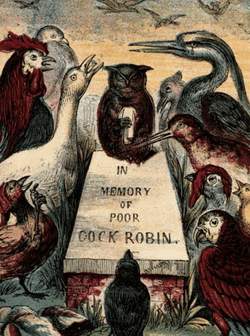
"Who killed Cock Robin?" "I," said the Sparrow,
"With my bow and arrow, I killed Cock Robin."
"Who saw him die?" "I," said the Fly,
"With my little eye, I saw him die."
"Who caught his blood?" "I," said the Fish,
"With my little dish, I caught his blood."
"Who'll make the shroud?" "I," said the Beetle,
"With my thread and needle, I'll make the shroud."
"Who'll dig his grave?" "I," said the Owl,
"With my pick and shovel, I'll dig his grave."
"Who'll be the parson?" "I," said the Rook,
"With my little book, I'll be the parson."
"Who'll be the clerk?" "I," said the Lark,
"If it's not in the dark, I'll be the clerk."
"Who'll carry the link?" "I," said the Linnet,
"I'll fetch it in a minute, I'll carry the link."
"Who'll be chief mourner?" "I," said the Dove,
"I mourn for my love, I'll be chief mourner."
"Who'll carry the coffin?" "I," said the Kite,
"If it's not through the night, I'll carry the coffin."
"Who'll bear the pall? "We," said the Wren,
"Both the cock and the hen, we'll bear the pall."
"Who'll sing a psalm?" "I," said the Thrush,
"As she sat on a bush, I'll sing a psalm."
"Who'll toll the bell?" "I," said the bull,
"Because I can pull, I'll toll the bell."
All the birds of the air fell a-sighing and a-sobbing,
When they heard the bell toll for poor Cock Robin.
"With my bow and arrow, I killed Cock Robin."
"Who saw him die?" "I," said the Fly,
"With my little eye, I saw him die."
"Who caught his blood?" "I," said the Fish,
"With my little dish, I caught his blood."
"Who'll make the shroud?" "I," said the Beetle,
"With my thread and needle, I'll make the shroud."
"Who'll dig his grave?" "I," said the Owl,
"With my pick and shovel, I'll dig his grave."
"Who'll be the parson?" "I," said the Rook,
"With my little book, I'll be the parson."
"Who'll be the clerk?" "I," said the Lark,
"If it's not in the dark, I'll be the clerk."
"Who'll carry the link?" "I," said the Linnet,
"I'll fetch it in a minute, I'll carry the link."
"Who'll be chief mourner?" "I," said the Dove,
"I mourn for my love, I'll be chief mourner."
"Who'll carry the coffin?" "I," said the Kite,
"If it's not through the night, I'll carry the coffin."
"Who'll bear the pall? "We," said the Wren,
"Both the cock and the hen, we'll bear the pall."
"Who'll sing a psalm?" "I," said the Thrush,
"As she sat on a bush, I'll sing a psalm."
"Who'll toll the bell?" "I," said the bull,
"Because I can pull, I'll toll the bell."
All the birds of the air fell a-sighing and a-sobbing,
When they heard the bell toll for poor Cock Robin.
This English folksong is believed to reference the death of Robin Hood and reflects the respect that common folk has for him.
Pop Goes the Weasel

Half a pound of tuppenny rice,
Half a pound of treacle.
That’s the way the money goes,
Pop! goes the weasel.
Up and down the City road,
In and out the Eagle,
That’s the way the money goes,
Pop! goes the weasel.
Half a pound of treacle.
That’s the way the money goes,
Pop! goes the weasel.
Up and down the City road,
In and out the Eagle,
That’s the way the money goes,
Pop! goes the weasel.
This Cockney rhyme dates back to the 1700s. The Cockney community developed a slang all their own because they mistrusted strangers and police. "Pop goes the weasel" was actually slang for "pawn your coat" and the Eagle refers to a pub, said to have been frequented by Charles Dickens. The pub was bought by the Salvation Army in 1883 and all drinking and music stopped.
Labels: Informative, Interesting, Story
# posted by Dany @ 4:01 AM
Tuesday
A Christmastime Love Story

Christmastime always transformed me.
It made my heart expand in my chest, placing me in perpetual rapture for at least two months out of the year. I was inevitably intoxicated by the twinkling lights, the smell of cookies baking, our family's annual trip to the tattered Christmas display at Fountains of Wayne.
But riding the subway while donning a Santa suit required a certain extra something… an un-self-consciousness that allowed you to pretend that everything was business as usual, despite the fact that you were wearing a dirndl made out of a Christmas tree skirt from the dollar store. I didn't really have that something, but I was trying to pull it off as best I could. It helped that I wasn't alone. Somehow, I had talked my boyfriend into joining me.
Our relationship had never been boring. After meeting on Friendster (of all places) two years earlier, I immediately began dragging him along to a series of Moroccan restaurants, dive bars, and techno clubs I was reviewing for a forthcoming nightlife guide. It was my only source of income, but he didn't seem to mind. He told his friends that I made life exciting. Later on in our relationship, he submitted further, dutifully attending cuddle parties and sexy soirees with me, and even trying out a handcuff set and various vibrating toys—and participating in an associated photo shoot—for Women's Health magazine. He may not have been completely comfortable, but he always tried to keep an open mind.
Now, he was standing beside me, wearing a full Santa suit courtesy of Party City, clutching a hat and fake beard in his fist, and staring pointedly at his spat-clad sneakers. This time, we were trying out Santacon, an annual dawn-to-dark mass gathering that celebrated spontaneity, ingenuity, and riotous holiday cheer. Creative costuming? All-day drinking? Christmas? I couldn't help but want to be involved. We arrived at our destination by 10 a.m. and, by 10:15, there were hundreds of us gathered in a park just within the Brooklyn city limits. It was at this time that the great, lumbering machine that was Santacon headed for the Brooklyn Bridge. Michael and I allowed ourselves to be swept up in the oversized scale of it all, staring around like a couple of hicks as we headed into Manhattan en masse. It was about 11 a.m. when we all crowded into South Street Seaport, taking over a pub on the third floor of the mall. We were cold and windburned, and smooshed ourselves eagerly—shoulder to shoulder—into all available seats. We simultaneously angled for the bartender's attention and introduced ourselves around, trying to down our beers before the word came to move on.
We stormed the financial district next, gathering on the steps of the New York Stock Exchange and bellowing out raunchy holiday lyrics for the onlookers. Looking at Michael mid-holler, I thought that I had never seen him happier.
We eventually relinquished our hold on the NYSE and continued on, in search of our next beer. We spread out in scraggly groups along the sidewalks, heading uptown. The side streets beckoned with their benches and charmingly placed lampposts, and Michael kept begging me to stop for a moment and enjoy the scenery. I, however, was loath to exit the predominately red current, afraid that we would lose the trail (though how anyone could possibly lose track of hundreds of Santas is now beyond me).
Michael finally gave up and pulled closer. "You're making this difficult," he said, "so I'll just have to do this while we're walking. Would you be my Mrs. Claus?"
I looked up at him with my nostrils flared, sure he was joking.
He stuck a hand down his Santa pants—which he was practically swimming in—and dug deep, trying to find the pocket of his sweatpants. When his hand finally reemerged, he was holding a jewelry box that was immediately familiar to me, pale gray and velvet. He struggled out of his oversized Santa gloves and opened the box that contained my great-grandmother's engagement ring. "Would you be my Mrs. Claus?" he repeated, completely earnest.
If I had thought that the magnitude of Santacon could not be matched, I was wrong. At that moment, the event—and its hundreds of participants—receded until there was only the two of us. He walked along beside me, still holding the ring box and waiting for my answer.
Considering all that he had subjected himself to over the past couple of years—and all in the name of love—how could I turn him down?
Feeling both exhilarated and slightly drunk, I found myself saying yes to the scariest thing of all.
Labels: Christmas, sexy, Story
# posted by Dany @ 2:16 AM

Subscribe to Posts [Atom]